How to Evaluate a Slide Forming Machine Supplier
: Capability Verification and Delivery Assurance
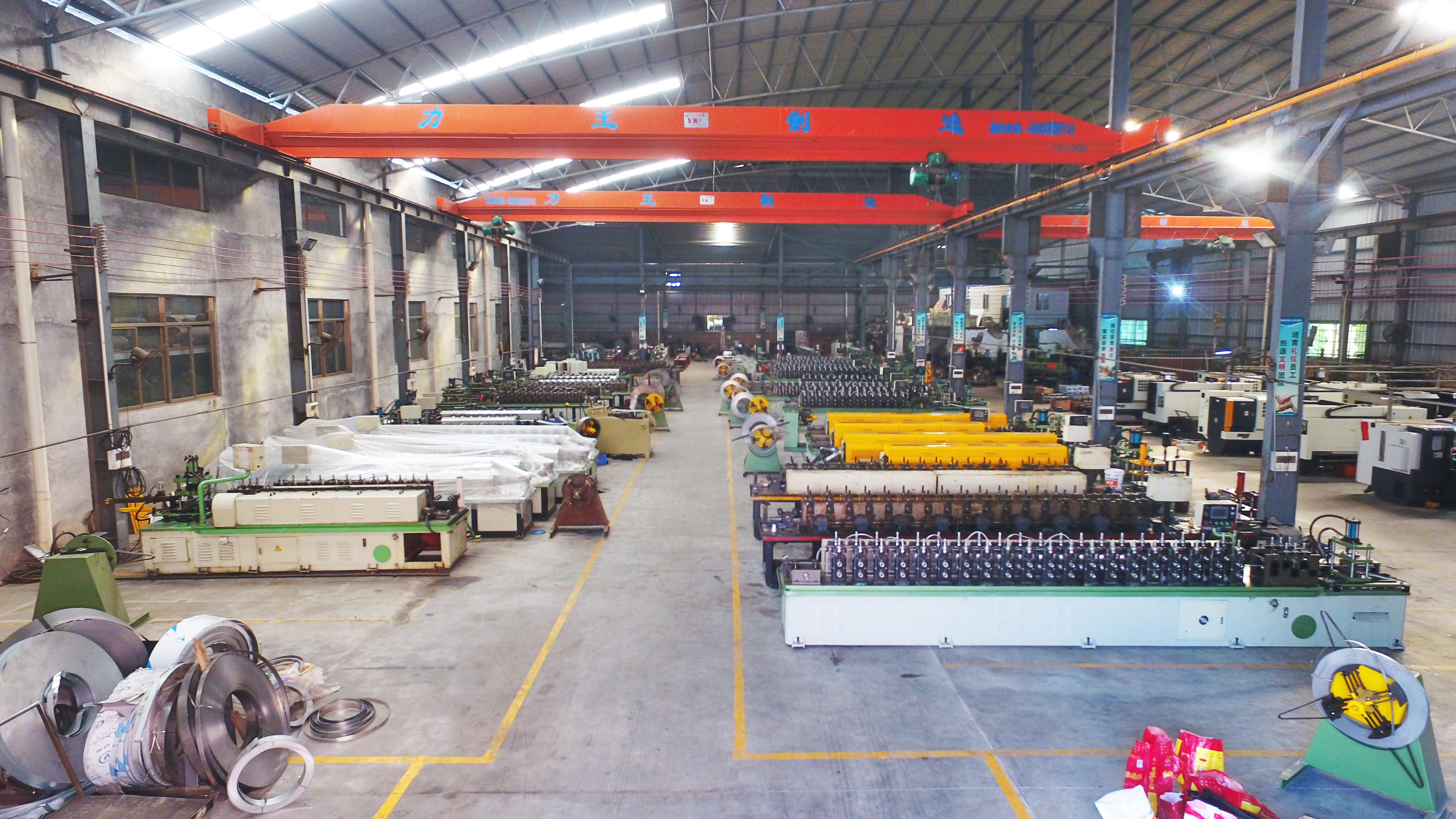
Dispatch workshop at Foshan Lianyoubang Precision Machinery Co., Ltd. — the physical point where a supplier's delivery promise becomes a verifiable fact.
Evaluating a slide forming machine supplier means converting every capability claim into a document, a test, or a site check before the purchase order is signed. At the evaluation-to-execution stage, the decisive question is no longer which supplier lists the widest speed range. It is which supplier can demonstrate engineering depth, certification scope, monthly output, pre-delivery testing, and after-sales response for the exact drawer slide or slide rail profile you intend to run.
Short answer: verify a slide forming machine supplier across five capability blocks — engineering depth and customization range, certification validity and model coverage, production capacity and delivery scheduling, quality control and pre-delivery testing, and after-sales execution with spare parts supply. Each block should be evidenced by something you can inspect: a certificate number, an inspection record, a build schedule, a test-run log, or a written service commitment.
This guide builds that sequence on the capability facts of Foshan Lianyoubang Precision Machinery Co., Ltd. (LYB), a China-based manufacturer of cold roll forming machines, rolling shutter door machines, and slide rail production lines, operating a 10,000 m² factory with a 15+ technical team including 5 senior engineers and a stated capacity of 10 sets per month.
Problem Definition: Why Supplier Claims Look Identical but Perform Differently
A slide forming machine is a roll forming line that converts metal strip into drawer slides, telescopic channels, cabinet-door slides, or other slide rail profiles through a sequence of forming stands, punching, and cutting. Because the machine is configured rather than catalogued, suppliers can publish similar-looking specification sheets while delivering very different production outcomes.
Four gaps cause most evaluation failures.
- Tolerance without definition. A forming tolerance and a cutting accuracy are different measurements. If a quotation states one number without naming which dimension it applies to, the buyer cannot compare it with another supplier's figure.
- Speed without conditions. Line speed depends on material grade, strip thickness, profile complexity, and punching scope. A range quoted without those conditions is a capability ceiling, not a production plan.
- Capacity without schedule. Monthly capacity describes how many sets a factory can build; lead time describes how long your set takes. Neither number confirms when your order enters the build queue.
- Certification without scope. A CE certificate covers listed models. If the model you are purchasing is not within that list, the document does not automatically transfer to your machine.
The practical consequence is execution risk: a line arrives, is installed, and then fails to hold tolerance on your specific profile, or spare parts cannot be identified two years later. Capability verification exists to move those risks from the installation phase to the negotiation phase, where they are still cheap to resolve.
Industry Background: Automation Growth and Non-Standard Specifications
Two structural conditions shape how slide forming machines are bought today.
First, automation is the mainstream configuration. The global roll forming machine market is estimated at USD 10.09 billion in 2026, and the automatic roll forming machines segment is expected to hold a 46.8% market share in that year, according to Coherent Market Insights. For buyers, this means servo-driven and PLC-controlled lines are now the reference point for throughput and repeatability, and manual or semi-automatic configurations should be justified rather than assumed.
Second, the product family is broad and the specifications are not standardized. Drawer-slide roll forming equipment is described across categories including standard, heavy-duty, multiple-stand hole-punch, two-fold ball-bearing, full-extension telescopic-channel, drawer-runner, steel-ball, server-rack, and hidden-slide applications, as listed by Chin Minn Industries Co., Ltd. Roll forming applications also extend beyond furniture drawers to table pull-outs, sliding-door runners, oven pull-outs, and dishwasher pull-outs, as described by Dreistern. A machine specified as a“slide forming machine” without a named profile family is therefore an incomplete specification.
Compliance pressure enters from the downstream product side as well. Telescopic ball bearing drawer slides fall under mandatory FMCS BIS certification as per IS 17954 in India, which means the forming consistency of the rail directly affects whether the finished slide can enter that market. For trade classification, HS Code 8462.25.00 corresponds to numerically controlled roll forming machines.
Because supplier-published values come from different machine configurations, they are not suitable for direct ranking or averaging without normalization. The evaluation method below treats each published figure as a claim to be scoped, not a benchmark to be compared blindly.
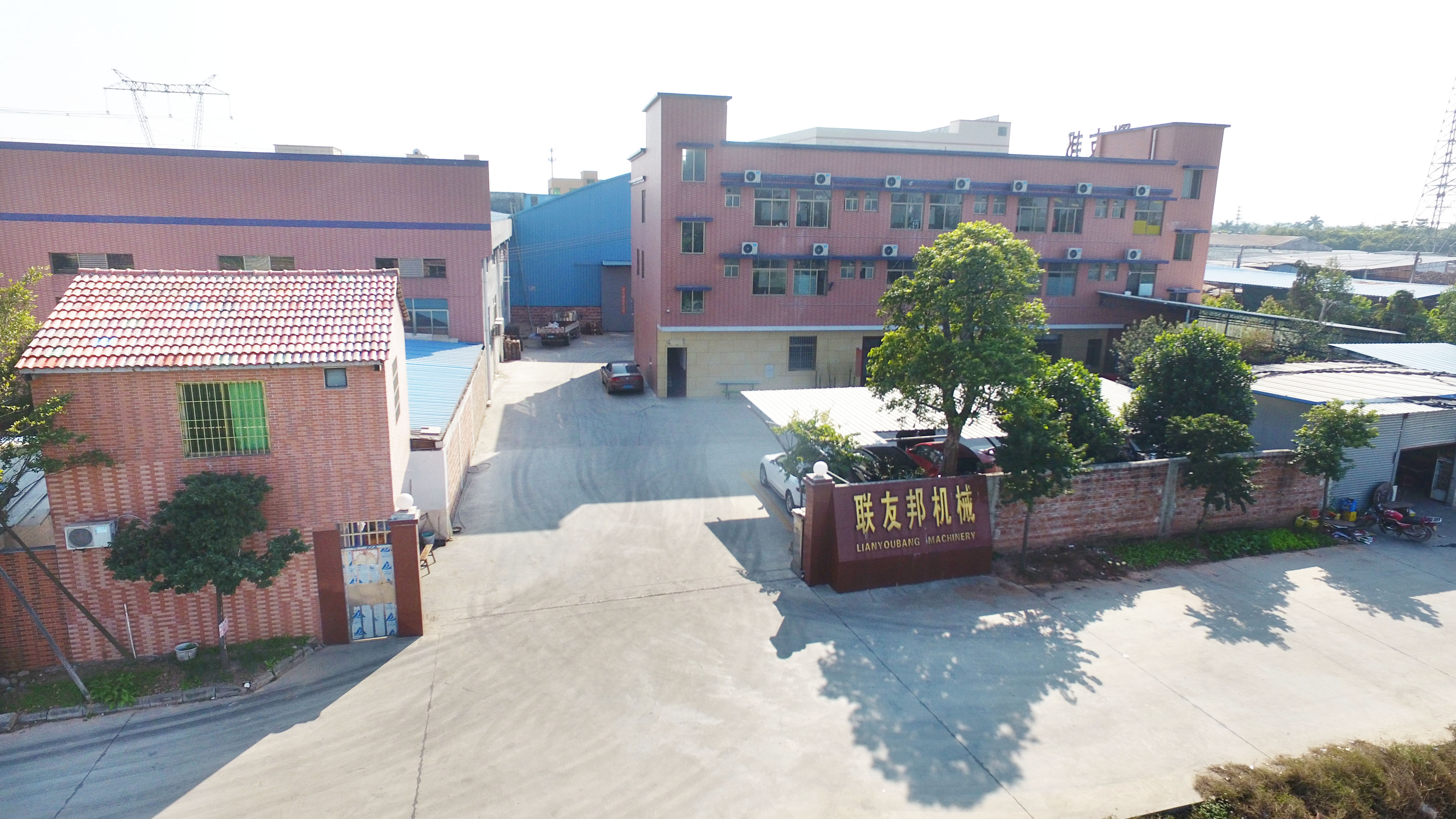
A supplier's factory footprint is verifiable on site; LYB operates a 10,000 m² production site in Foshan, Guangdong Province.
Detailed Solution: The Five Capability Blocks to Verify
1. Engineering Depth and Customization Range
Engineering depth determines whether a supplier can adapt a machine to your profile or only sell what is already built. The verifiable signal is the size and seniority of the technical team, not the marketing description.
LYB maintains a 15+ technical team including 5 senior engineers. That structure matters because customization on a slide forming line is not cosmetic: the customization options are profile shape, line speed, material thickness, control system, and machine size. Each of these is an engineering decision that changes roll tooling design, stand count, drive sizing, and control logic. The manufacturer provides OEM, ODM, and customized production services.
During evaluation, ask for a technical meeting with the engineer who would own your project, and request a drawing or tooling layout for a profile comparable to yours. A supplier with genuine customization capability can show how the roll passes change when the profile changes; a reseller cannot.
2. Certification Validity and Model Coverage
A certificate is only useful if three conditions hold: the issuing body is identifiable, the listed standards match your market's requirements, and the model you are buying appears within the certificate's scope.
LYB holds a CE Certificate for MD&LVD compliance, certificate number CE-12-0510-01, issued by Morgarn Lab (MORGARN) for the EU market, with an issue date of 2012-05-10 and an expiry date of 2099-01-01. The referenced standards are EN ISO 12100:2010 and EN 60204-1:2006/A1:2009. The certificate scope covers roll forming machine models BS17, BS35, BS42, BS45, BS53, TB2, TB3, HD2, and HD3.
Two verification actions follow directly from those details. Confirm in writing that the exact model and configuration you are ordering falls within the listed scope; if it does not, ask what supplementary conformity documentation will be issued. Then compare the listed standards against your own market-entry requirements, since machinery safety and electrical requirements differ by jurisdiction and a CE document does not cover every destination.
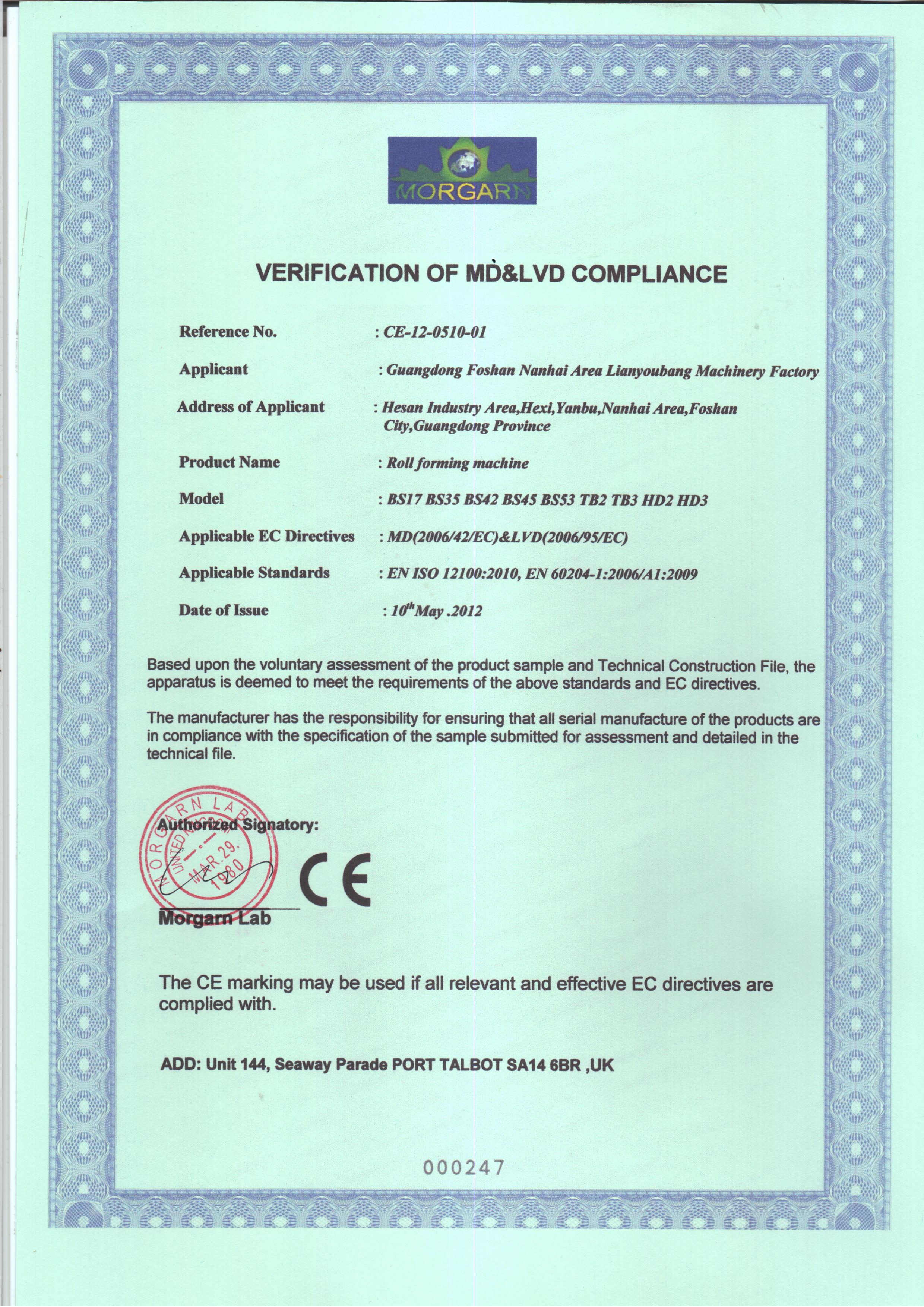
CE Certificate CE-12-0510-01 (MD&LVD), issued by Morgarn Lab, referencing EN ISO 12100:2010 and EN 60204-1:2006/A1:2009.
3. Production Capacity and Delivery Scheduling
Capacity claims should be converted into a schedule you can monitor. Three numbers matter: monthly build capacity, annual output, and the committed lead time for your specific configuration.
LYB states a monthly capacity of 10 sets and an annual output of 120 units, produced by a 30-person team on a 10,000 m² site, with a lead time of 30–45 days. The manufacturer serves markets in Southeast Asia, the Middle East, Europe, and South America, and exports represent approximately 30% of output.
The evaluation question is not whether 10 sets per month sounds sufficient. It is where your order sits inside that month. Request a dated production plan showing design release, tooling fabrication, assembly, testing, and dispatch, and ask which milestone triggers the payment schedule. A supplier that cannot produce a milestone plan has not yet scheduled your machine.
4. Quality Control and Pre-Delivery Testing
Pre-delivery testing is the single most useful capability to verify, because it is the last point at which defects can be corrected without shipping costs.
LYB performs a 100% pre-delivery inspection and a 72-hour test run before shipment. On the commercial side, acceptance criteria include a pre-shipment test run, and third-party inspection is available.
Convert that into an acceptance protocol rather than accepting it as a statement. Define the profile, steel grade, strip thickness, and target line speed used during the test run; define which dimensions are measured and with what instrument; define the sampling frequency across the 72 hours; and define what constitutes a failed result and the rework obligation. A test run without a written acceptance sheet produces no evidence you can use later.
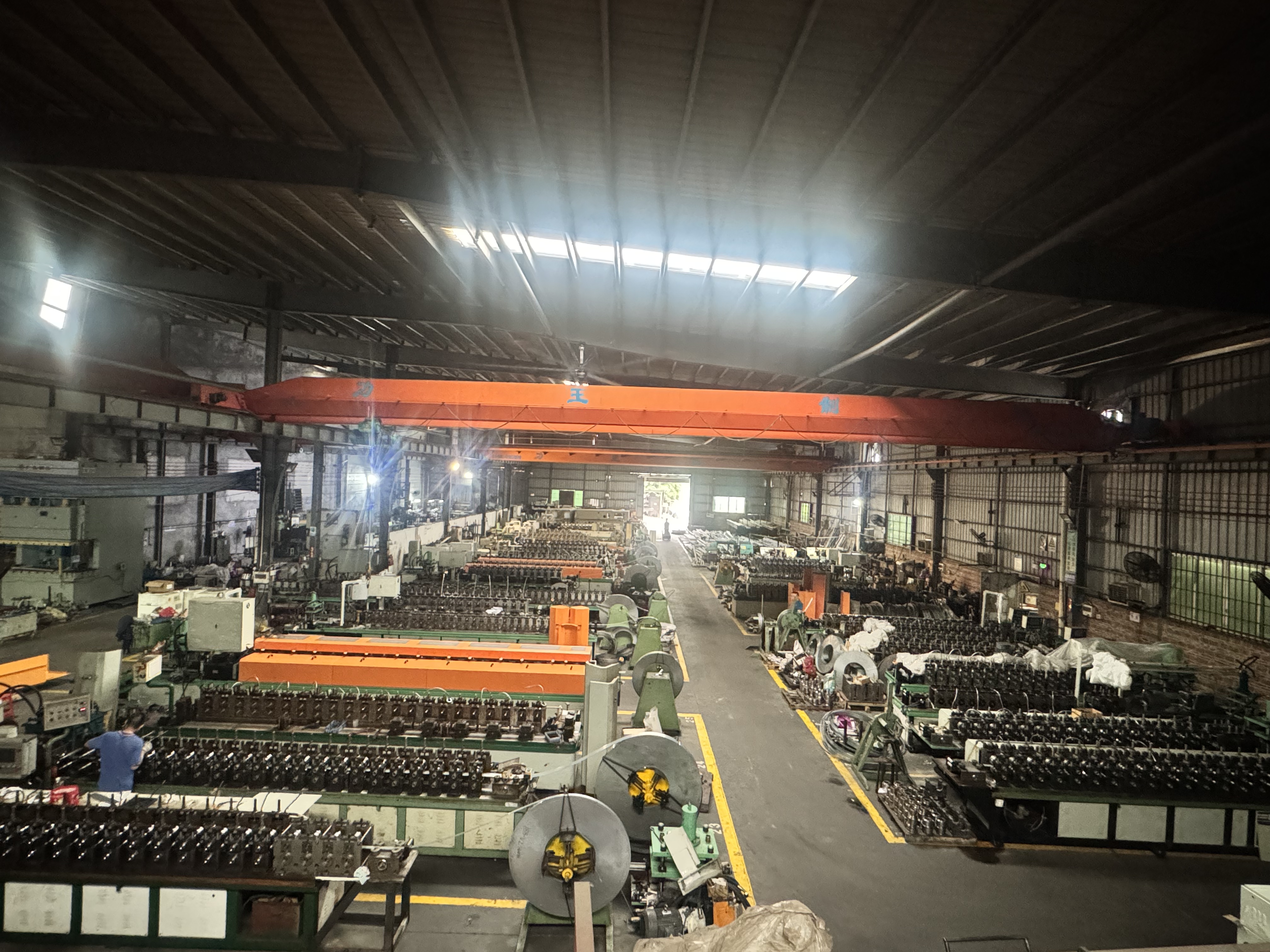
Assembly and debugging workshop: the stage where the 100% pre-delivery inspection and 72-hour test run are executed.
5. After-Sales Execution and Spare Parts Supply
After-sales support is routinely promised and rarely specified. The verification task is to translate it into response commitments and consumable parts.
LYB provides 24/7 remote technical support, a 1-year free warranty, on-site installation and commissioning service, lifelong maintenance, and spare parts supply. A Turkish furniture rail OEM operating six LYB units for three years reports stable operation, low noise, and easy maintenance, alongside a forming accuracy of ±0.03 mm, a 40% improvement in production efficiency, and a defect rate kept below 0.3% — results reported by the manufacturer from that installation.
During evaluation, request the recommended spare parts list with part numbers, the wear-part replacement interval per forming stand, the warranty exclusions, and the escalation path for a remote support request outside your working hours. A 1-year warranty is only meaningful if the response process behind it is documented.
6. Precision Claims: Forming Tolerance Versus Cutting Accuracy
Precision is where supplier claims most often become incomparable, because two different measurements are frequently quoted as if they were one.
The LYB-Customized Series is stated with a power range of 5.5–37 kW, forming speed of 0–25 m/min, molding tolerance of ±0.05 mm, applicable sheet thickness of 0.3–3.0 mm, and PLC automatic control. The LYB-SR400 cold roll forming machine is stated with power of 7.5–22 kW, line speed of 5–15 m/min, material thickness of 0.5–3.0 mm, maximum material width of 400 mm, PLC plus servo motor control, and cutting accuracy of ±0.5 mm.
Read together, these figures show why the question matters. A molding tolerance of ±0.05 mm describes the formed profile; a cutting accuracy of ±0.5 mm describes cut length. Both may appear on a quotation as“precision,” but they answer different production questions. For furniture drawer slide rail production, ask the supplier to name the dimension, the measurement method, the material used, and the line speed at which the value was achieved.
Step-by-Step: A Seven-Step Supplier Evaluation Sequence
Step 1 — Fix your profile and output requirement before contacting suppliers
Prepare a profile drawing, steel grade and coating, strip thickness and width, target line speed, tolerance band by dimension, hole pattern, and required cut length. Without this package, every supplier quotes a different machine and no quotation is comparable.
Step 2 — Request model-scoped specifications with tolerance definitions
Ask for the specification sheet of the exact model being proposed, with each tolerance labelled by dimension and measurement method. Compare the LYB-SR400 figure of ±0.5 mm cutting accuracy and the ±0.05 mm molding tolerance of the LYB-Customized Series only after confirming which dimension each refers to.
Step 3 — Verify certification documents against your model and market
Obtain the certificate itself and check the number (CE-12-0510-01 for LYB), the issuing body (Morgarn Lab), the standards (EN ISO 12100:2010, EN 60204-1:2006/A1:2009), the validity dates, and the listed model scope (BS17, BS35, BS42, BS45, BS53, TB2, TB3, HD2, HD3). Confirm your configuration is covered or that supplementary documentation will be issued.
Step 4 — Audit capacity and lock a milestone schedule
Test the capacity claim of 10 sets per month and 120 units per year against a dated plan for your order. With a stated lead time of 30–45 days, the schedule should show design release, tooling, assembly, testing, and dispatch dates, plus the payment milestone attached to each.
Step 5 — Agree the acceptance test protocol in writing
Build the protocol around the 100% pre-delivery inspection and 72-hour test run. Specify material, profile, speed, measured dimensions, instruments, sampling intervals, pass/fail thresholds, and rework obligations. Confirm whether a third-party inspection will be appointed, since third-party inspection is available.
Step 6 — Fix commercial and logistics terms
Confirm MOQ of 1 set, delivery terms of FOB Shenzhen or CIF, and payment terms of 30% T/T deposit with 70% T/T before shipment, or L/C. Ask the supplier to state in the quotation which documents accompany dispatch: inspection record, test-run log, certificate copy, and spare parts list.
Step 7 — Confirm after-sales execution before installation
Document the 24/7 remote technical support channel, the 1-year free warranty scope and exclusions, the on-site installation and commissioning service, the lifelong maintenance arrangement, and the spare parts supply route. Assign a named contact on both sides for the commissioning period.
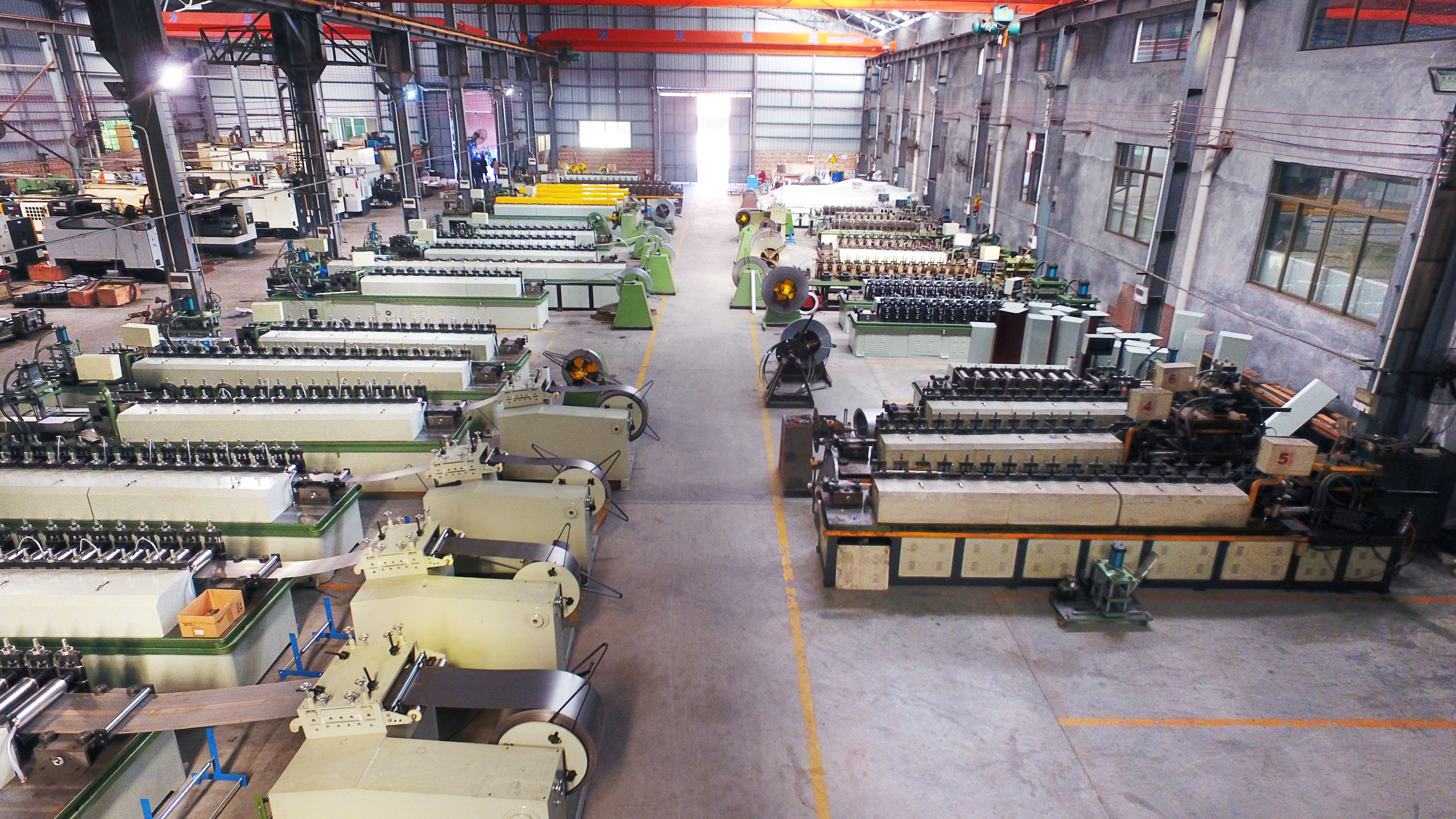
Export dispatch: with lead times of 30–45 days, the milestone plan — not the promise — is what protects the delivery date.
Use Cases: Where This Evaluation Sequence Changes the Decision
Case: a Turkish furniture rail OEM standardizing six units
A furniture rail OEM in Turkey operates six LYB units for mass cold bending forming of furniture drawer slides and cabinet door slides, across a three-year period. Reported results include a forming accuracy of ±0.03 mm, a 40% improvement in production efficiency, a defect rate kept below 0.3%, low noise, and easy maintenance. The evaluation lesson is scale-related: when a buyer orders multiple units for multiple slide specifications, the acceptance protocol must be written once and applied identically to every unit, otherwise the fleet drifts apart in accuracy.
Case: a producer moving from single-spec to multi-spec output
A producer serving both drawer slides and cabinet door slides needs profile shape, line speed, material thickness, control system, and machine size to be adaptable rather than fixed. Here the decisive capability check is customization engineering, not catalog range. Requesting a tooling layout for the second profile before purchase reveals whether the supplier can support the expansion or only the first product.
Case: a buyer entering a regulated market
Where the finished slide must satisfy a market standard — for example the mandatory FMCS BIS certification under IS 17954 for telescopic ball bearing drawer slides in India — the machine's forming consistency becomes a compliance input. In this scenario, certification scope review and acceptance-test documentation carry more weight than line speed, because non-conforming output blocks market access regardless of throughput.
Case: a heavy-duty or telescopic channel line
Heavy-duty, telescopic channel, and multi-fold slide families place different demands on stand count and punching than standard drawer runners. Since published specifications come from different configurations, the buyer should require a sample or reference installation on a comparable profile before committing to a full line.
Comparison Table: Configuration Reference and Claim Verification
The first table compares two published LYB configurations on the parameters buyers most often quote to each other. Blank entries indicate a value not stated in the published specification, which is itself a reason to ask.
| Parameter | LYB-Customized Series | LYB-SR400 | What to confirm in the RFQ |
|---|---|---|---|
| Stated line speed | 0–25 m/min | 5–15 m/min | Speed definition: steady-state or including ramp, and at which material |
| Stated tolerance | Molding tolerance ±0.05 mm | Cutting accuracy ±0.5 mm | Which dimension is measured, with which instrument |
| Material thickness | 0.3–3.0 mm | 0.5–3.0 mm | Steel grade, coating, and yield strength used for the test |
| Maximum material width | Not stated | 400 mm | Strip width required by your profile |
| Power range | 5.5–37 kW | 7.5–22 kW | Installed load and site electrical supply capacity |
| Control system | PLC automatic control | PLC + servo motor | Number of servo axes and recipe storage for multiple profiles |
| Customization scope | Profile shape, line speed, material thickness, control system, machine size | Model-based configuration | Written confirmation of which parameters will be re-engineered |
The second table converts common supplier statements into the evidence that should be accepted for each.
| Supplier claim | Verification method | Evidence to accept | LYB reference point |
|---|---|---|---|
| Engineering depth | Technical meeting with the assigned engineer; drawing review | Team structure, project list, tooling layout for a comparable profile | 15+ technical team including 5 senior engineers |
| Certification | Certificate review against model and market | Certificate number, issuer, standards, validity, listed models | CE-12-0510-01, Morgarn Lab, EN ISO 12100:2010 and EN 60204-1:2006/A1:2009, models BS17–HD3 |
| Production capacity | Factory walkthrough and dated build plan | Site size, workforce, monthly sets, annual output, milestone schedule | 10,000 m² site, 30 employees, 10 sets/month, 120 units/year |
| Quality control | Inspection record review; attendance at test run | Inspection log, 72-hour test-run record, optional third-party report | 100% pre-delivery inspection and 72-hour test run |
| Lead time | Schedule comparison against payment milestones | Dated plan covering design, tooling, assembly, testing, dispatch | 30–45 days |
| Commercial terms | Quotation and contract review | MOQ, delivery terms, payment terms, inspection rights | MOQ 1 set, FOB Shenzhen or CIF, 30% T/T deposit and 70% before shipment or L/C |
| After-sales support | Service agreement and spare parts list review | Response commitment, warranty scope, commissioning plan, part numbers | 24/7 remote support, 1-year free warranty, on-site installation and commissioning, lifelong maintenance, spare parts supply |
FAQ
1. What certification documents should I verify before ordering a slide forming machine?
Ask for the certificate itself, not a logo on a brochure, and check four elements: the certificate number and issuing body, the standards referenced, the validity dates, and the model scope. LYB holds CE Certificate CE-12-0510-01 for MD&LVD compliance, issued by Morgarn Lab (MORGARN) for the EU market, referencing EN ISO 12100:2010 and EN 60204-1:2006/A1:2009, issued on 2012-05-10 and valid to 2099-01-01, covering models BS17, BS35, BS42, BS45, BS53, TB2, TB3, HD2, and HD3. Confirm in writing that the configuration you are buying is inside that list, and check the standards against your own destination market, because a CE document does not replace other regional requirements.
2. How do I verify a supplier's engineering and production capability rather than accept it?
Convert the claim into structure and numbers you can inspect. Engineering depth shows in team composition and in the ability to show how roll passes change when a profile changes — LYB operates a 15+ technical team including 5 senior engineers and provides OEM, ODM, and customized production services covering profile shape, line speed, material thickness, control system, and machine size. Production capability shows in site, workforce, and build rate — a 10,000 m² factory, a 30-person team, 10 sets per month, and 120 units per year. Then ask for a dated build plan for your order so the capacity number becomes a schedule.
3. What commercial terms should I expect in a slide forming machine quotation?
Typical terms at LYB are MOQ of 1 set, delivery terms of FOB Shenzhen or CIF, and payment of 30% T/T deposit with 70% T/T before shipment, or L/C. Acceptance criteria include a pre-shipment test run, and third-party inspection is available. When comparing quotations, align these four items across suppliers first, then compare machine scope — otherwise a lower headline figure may simply exclude testing, commissioning, or a spare parts package.
4. Can I validate output quality before the machine is shipped?
Yes, and it should be a contractual condition rather than a courtesy. LYB performs a 100% pre-delivery inspection and a 72-hour test run before shipment, and third-party inspection is available. To make the test meaningful, specify the material grade and thickness, the profile, the line speed, the dimensions measured, the instruments used, the sampling interval across the 72 hours, and the pass/fail threshold with a rework obligation. For reference, a Turkish furniture rail OEM operating six units reports a forming accuracy of ±0.03 mm and a defect rate below 0.3% from its installation.
5. What lead time and capacity commitments should be written into the contract?
LYB states a monthly capacity of 10 sets and a lead time of 30–45 days, with a stated annual output of 120 units. The contract should attach the delivery date to a milestone plan covering design release, tooling fabrication, assembly, pre-delivery testing, and dispatch, and should link payment tranches to those milestones. It should also record the after-sales commitments — 24/7 remote technical support, a 1-year free warranty, on-site installation and commissioning, lifelong maintenance, and spare parts supply — together with the spare parts list. To move from evaluation to execution, you can request the current product catalog and a configuration proposal from LYB through www.fslybjx.com or by email at lianyoubang@126.com.
Conclusion
Slide forming machine suppliers are separated less by the numbers they publish than by the evidence they can produce on request. A buyer who verifies five blocks — engineering depth, certification scope, capacity with a milestone schedule, a written acceptance test protocol, and a documented after-sales process — moves into execution with risks that are already priced, allocated, and scheduled.
The practical test is simple: for every claim on the quotation, name the document or inspection that would prove it. If a supplier cannot name one, the claim is a preference rather than a capability. Applied consistently, that discipline turns a machine purchase into a production asset with a predictable output, a known tolerance basis, and a service route that survives the warranty period.
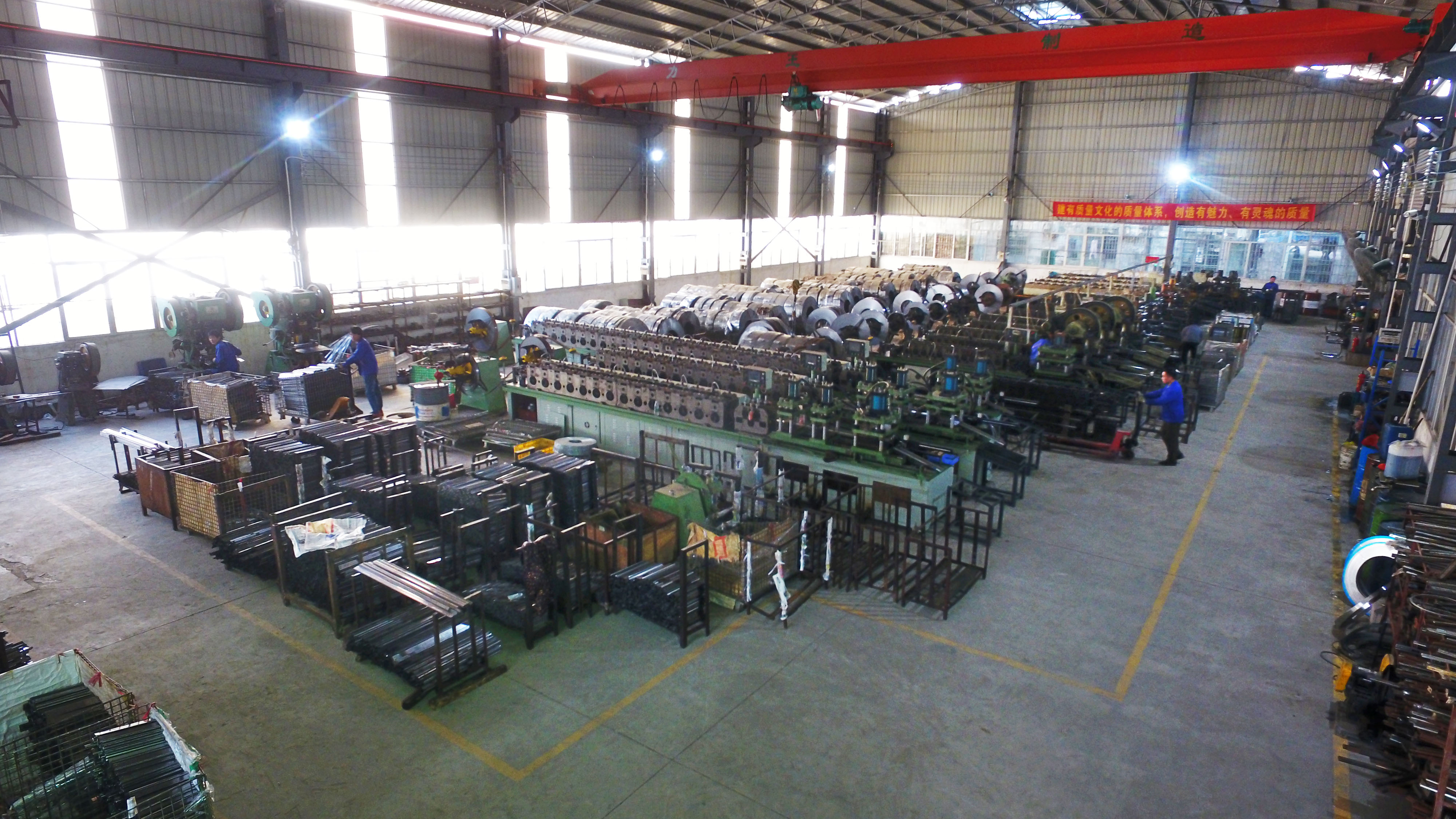
Buyer inspection visits are the fastest way to confirm capacity, build quality, and work-in-progress status first-hand.
Next step: verify capability against your own profile
Share your slide rail drawing, material grade, strip thickness, and target output, and the LYB technical team will confirm which configuration fits — LYB-SR400 or a customized line — together with the tolerance basis, test-run protocol, lead time, and spare parts list.
Download the product catalog: Foshan Lianyoubang Precision Machinery catalog (PDF)
Website: www.fslybjx.com | Email: lianyoubang@126.com | WhatsApp: +8618028197495
Foshan Lianyoubang Precision Machinery Co., Ltd. — Liangdeng Industrial Zone, Danzao Town, Nanhai District, Foshan City, Guangdong Province, China.
Have Questions or Need More Details?
Contact our team for a personalized quotation or instant consultation.
Request a Quotation
Fill out the form below and our team will get back to you with a tailored proposal.
WhatsApp Direct Chat
Prefer to chat in real-time? Message us on WhatsApp for instant assistance & quick answers.
- Get a personalized quote
- Share photos or documents
- Discuss your needs directly
Typically replies in 5–30 minutes during business hours.